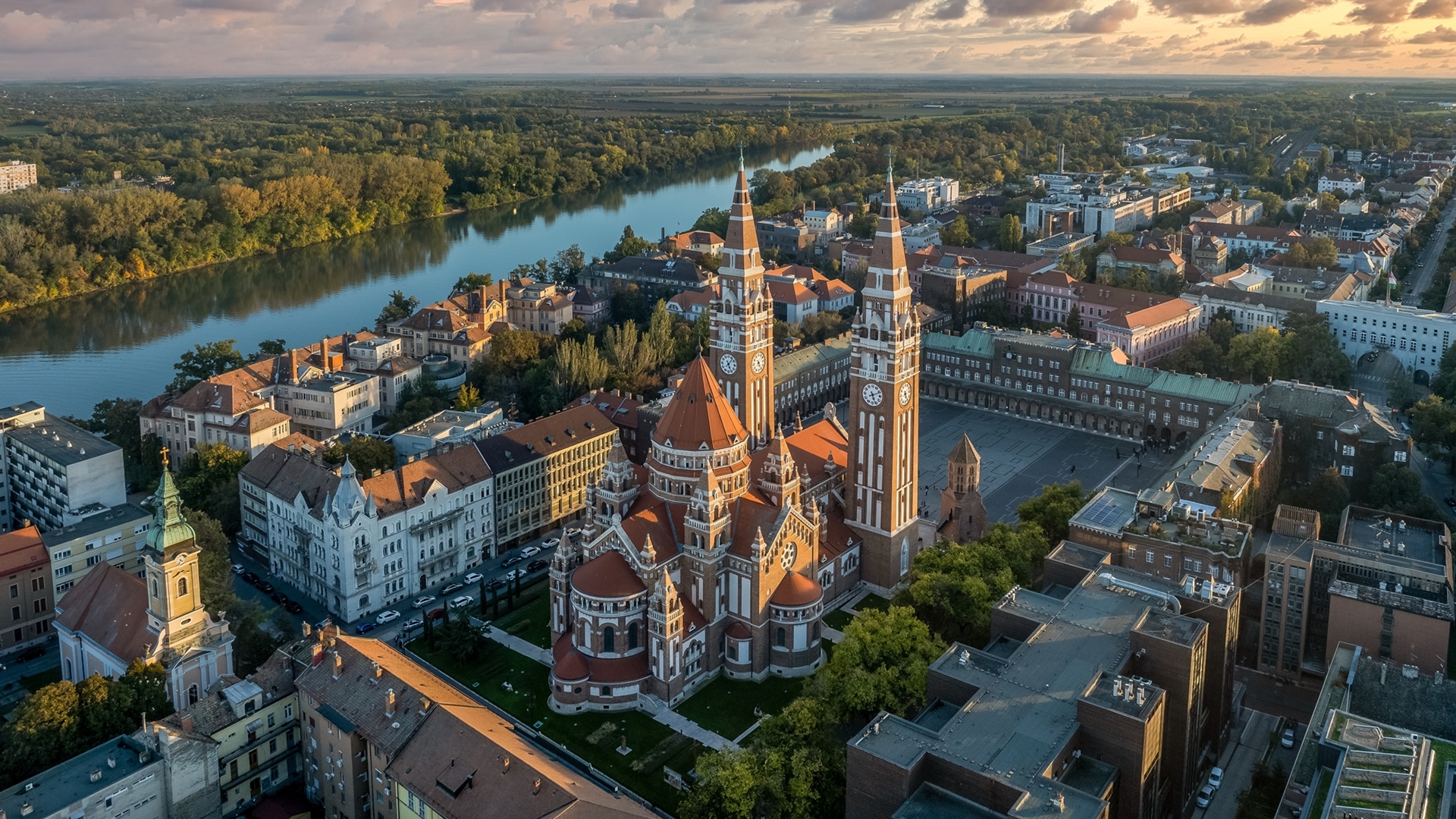
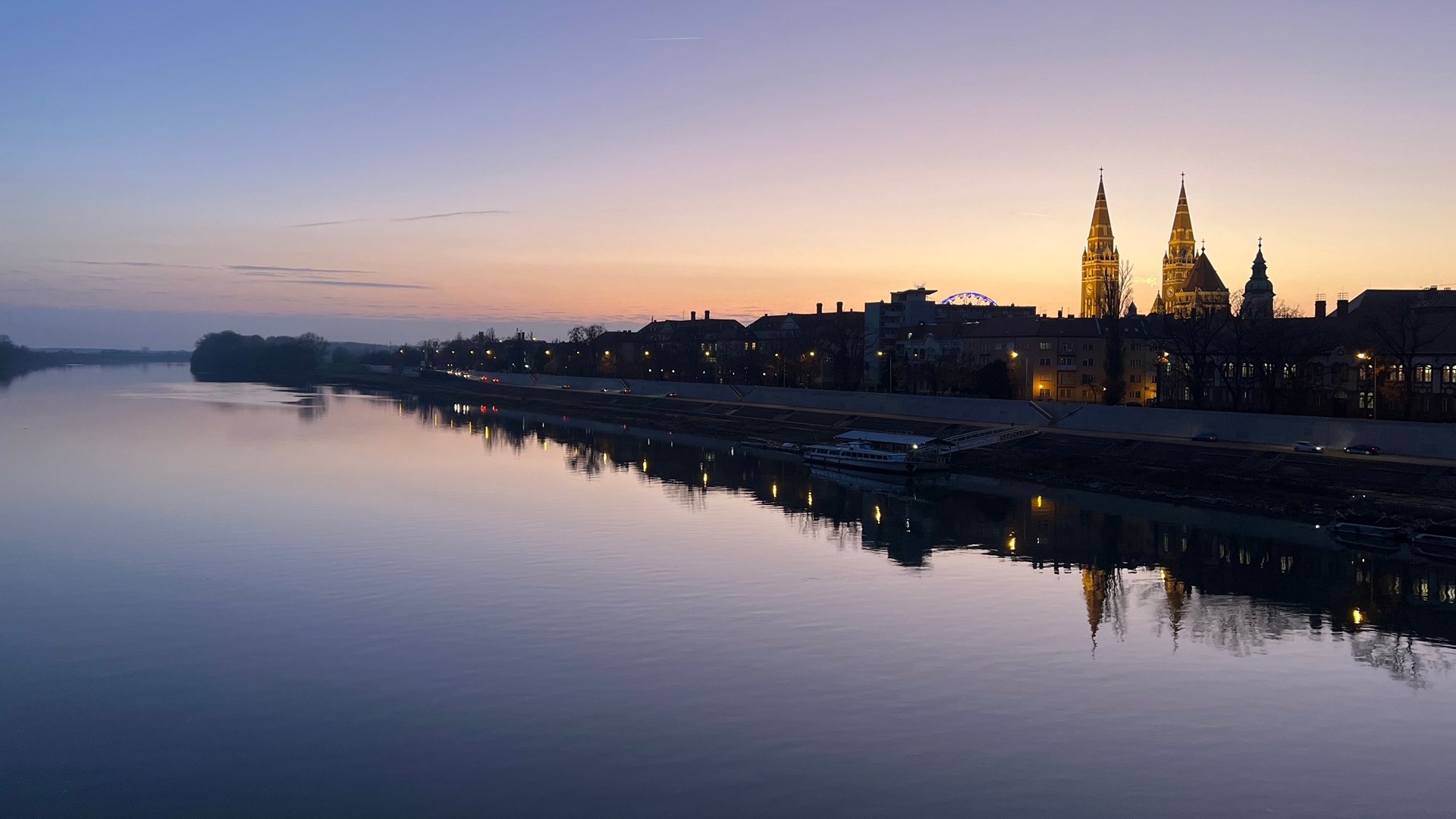
Goodwill Pharma’s home is Szeged, a city shaped by the life-giving power of the River Tisza, the brilliance of scientific discovery and stories that reach deep into European history. Situated in southern Hungary, close to the borders of Serbia and Romania, Szeged has always been a meeting place: of peoples and cultures, of East and West, of tradition and innovation. Known as the “City of Sunshine” for its exceptionally bright climate, Szeged combines the openness of the Great Hungarian Plain with the intellectual energy of one of Central Europe’s leading university cities. Its elegant avenues, Art Nouveau palaces, riverside promenades, cafés and vibrant cultural life give it a distinctive atmosphere—relaxed and welcoming, yet ambitious and forward-looking. For Goodwill Pharm a, Szeged is more than a location. It is part of our identity.
Szeged’s history has always been closely tied to the Tisza. For centuries, the river brought fertile soil, trade and prosperity — but it could also reveal its devastating power. In March 1879, a catastrophic flood almost completely destroyed the city. Rather than abandon their home, the people of Szeged chose to rebuild it on a grander scale. Support arrived from across Europe, and the reborn city later honoured its helpers by naming its new boulevards after cities such as Vienna, Berlin, Paris, London and Rome. The reconstruction transformed Szeged into the elegant city we know today, with spacious boulevards, a radial street plan and striking Historicist and Art Nouveau architecture.
The Great Flood therefore became more than a disaster. It became the central story of Szeged’s resilience: a city swept away by the river, yet rebuilt through courage, solidarity and imagination.
The Eternal Tisza
The Tisza remains the soul of Szeged. It divides and unites the city, reflects its skyline and determines the rhythm of its seasons. Its embankments are places for walking, conversation, sport and celebration, while its bridges connect the historic centre with Újszeged’s parks and gardens.
The river is also home to one of Europe’s most remarkable natural spectacles. On a few warm evenings in early summer, millions of mayflies known as the Tisza mayfly emerge from the water. Their brief, synchronised flight is called the “blooming of the Tisza”. It lasts only a few hours, yet it has become a powerful symbol of beauty, transformation and the preciousness of life.
The Tisza is therefore not merely part of the city’s geography. It is part of its imagination. It represents continuity and renewal, danger and protection, scientific curiosity and respect for nature.
Where Tradition
Inspires Innovation
Today, Szeged is a centre of medical science, biotechnology, pharmaceuticals, education and sustainable mobility.
Its location at the meeting point of three countries and its strong university tradition connect local talent with international knowledge. Goodwill Pharma was founded in this inspiring environment. We are proud to belong to a city where scientific achievement, curiosity and perseverance are part of the local heritage.
In the footsteps of attila
Long before modern Szeged emerged, the Great Hungarian Plain was a crossroads of powerful steppe cultures. In the fifth century, Attila the Hun ruled a vast empire from somewhere in the Carpathian Basin, likely near the wider Tisza region.
His residence and burial place have never been found. According to legend, Attila was buried beneath the bed of a diverted river, surrounded by iron, silver and gold, before the water was allowed to return and hide his grave forever. Later tradition connected this mysterious river with the Tisza.
Szeged also has a remarkable real connection to the Hun era. Near Nagyszéksós, archaeologists discovered one of the most important Hun-period princely treasures in the Carpathian Basin, including more than a kilogram of gold objects. Between archaeological evidence and enduring legend, the Tisza still seems to guard the secrets of Attila’s lost world.
The Witches of Szeged
A darker chapter of Szeged’s history is linked to Boszorkánysziget – Witches’ Island, a wooded area beside the Tisza. In 1728, the city became the site of Hungary’s most notorious witch trial. Amid drought, famine and social fear, several people were accused of witchcraft and executed near the river. Today, the story stands as a warning about prejudice and collective fear, while legend has transformed the witches into mysterious guardians of forgotten knowledge, herbs and nature. Boszorkánysziget is now a peaceful riverside landscape, but its name still preserves one of Szeged’s darkest and most mysterious stories.
The city of Albert szent-györgyi
Albert Szent-Györgyi, the Hungarian physician, biochemist and Nobel Prize winner, carried out some of his most important research at the University of Szeged. In the early 1930s, he and his colleagues discovered that Szeged’s famous paprika was an exceptionally rich source of vitamin C, helping make its isolation possible in significant quantities. In 1937, he received the Nobel Prize in Physiology or Medicine for discoveries related to biological combustion and vitamin C. His work created a remarkable link between Szeged’s agriculture, science and global medical progress. His spirit of curiosity and innovation still lives on in the city’s university and life-science community.
A Living Cultural City
Szeged’s culture lives in its streets, squares and everyday life. Each summer, Dóm Square transforms into a spectacular open-air theatre during the Szeged Open-Air Festival, with performances beneath the towers of the Votive Church.
The city’s theatres, museums, music scene and international university community give Szeged a lively, youthful character.
Its culture is also deeply connected to gastronomy, from Szeged paprika and traditional fish soup to Pick salami and the wines of southern Hungary.
Dear Visitor!
Our website uses cookies which are essential for the proper functioning of our website. We use cookies that are not essential for the personalisation of advertisements, the functioning of our social features and the analysis of our website traffic, and we use them with your consent. For more information, please see our Privacy Policy.